
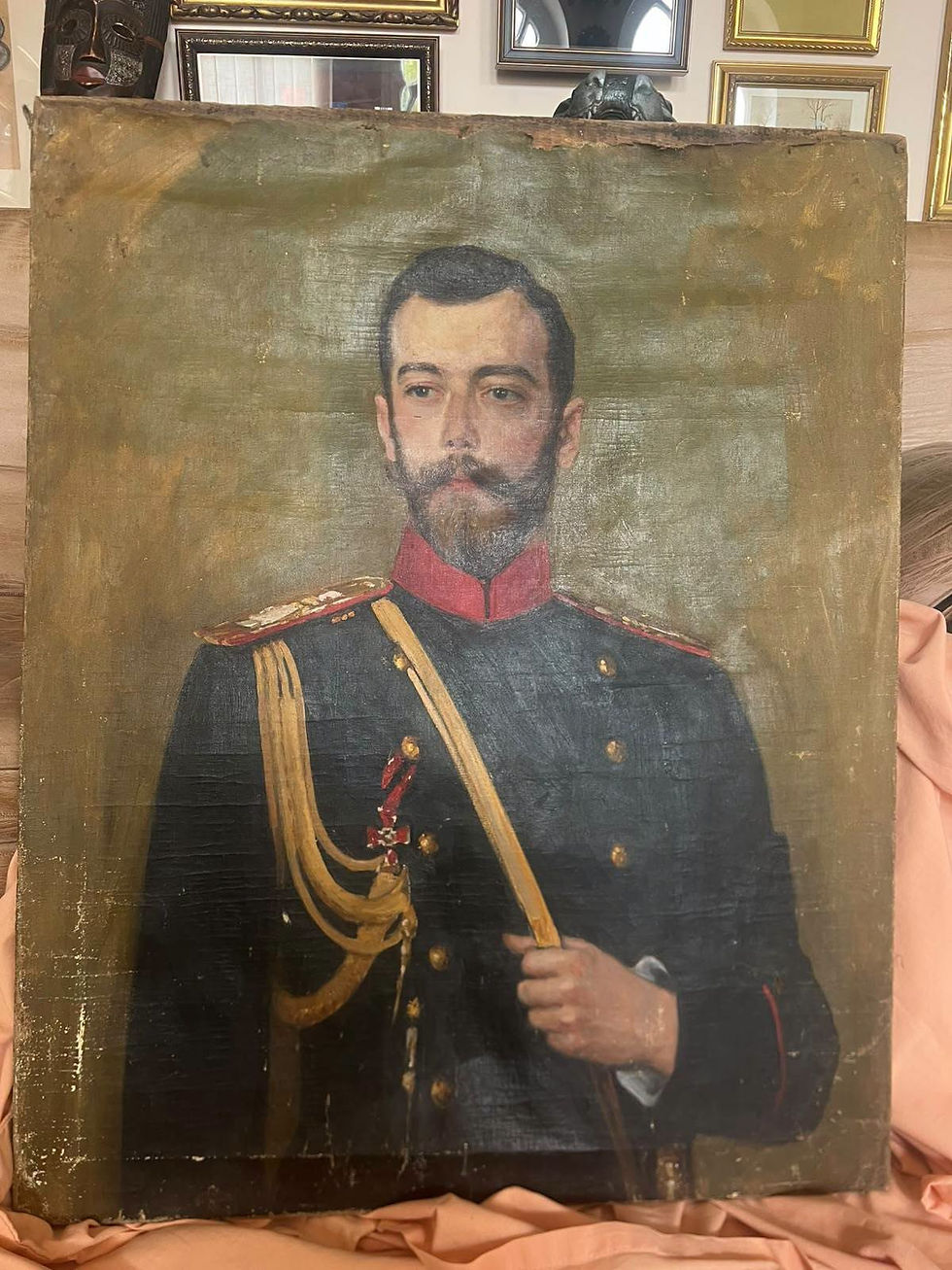
From a Landfill to a Museum Collection - A Portrait of Nicholas II
Yesterday, the discovery of a portrait of Emperor Nicholas II at a landfill in Tbilisi by the distinguished Georgian scholar and researcher, Ms. Nana Kardava, attracted considerable public attention.
With the integrity and sense of responsibility characteristic of a dedicated scholar and patriot, Ms. Kardava brought the painting to the museum today and donated it to the Art Palace.
We would like to express our deepest gratitude to Ms. Kardava. Thanks to her attentiveness and civic responsibility, another intriguing piece of cultural heritage has been saved from destruction.
The significance of the canvas extends beyond its historical context. It depicts Emperor Nicholas II, who is venerated as a saint in the Orthodox world. At the same time, the work possesses considerable artistic interest.
The compositional type of the portrait reveals striking similarities to the portraits of Emperor Nicholas II created by the great Russian painter Ilya Repin in 1895–1896. Repin produced several official portraits of the young emperor, and it was during this period that one of the most recognisable ceremonial iconographic types of Nicholas II took shape.
Particularly noteworthy parallels with Repin’s works can be observed in the emperor’s pose and turn of the head, the direction of his gaze, the dark military uniform with a red collar, the gold aiguillette, the diagonally positioned porte-épée, and the characteristic gesture of his right hand.
These similarities allow us, at this stage, to associate the painting with the portrait type of Nicholas II developed by Ilya Repin. However, identifying the direct authorship of the work requires further research. This will include a technical examination of the canvas, an investigation of its reverse side and any possible inscriptions, as well as a detailed comparison with Repin’s known versions and their copies.
The circumstances of the discovery make the story particularly significant. A painting of such historical and artistic interest was found entirely by chance by a dedicated Georgian scholar, on the verge of destruction, and has now been preserved in a museum collection.
Thanks to Ms. Nana Kardava’s attentiveness and civic responsibility, another valuable and intriguing piece of cultural heritage has been saved from permanent loss.
The Art Palace expresses its sincere gratitude to Ms. Nana Kardava for discovering the work and entrusting it to the museum.